
-
There are no articles in this category. If subcategories display on this page, they may have articles.
Subcategories
Current Peruvian Banknotes & Coins
Since 1991, the Peruvian currency is the “Nuevo Sol” (S/.), which was renamed to just “Sol” (S/) in 2016. It’s subdivided into 100 centimos (cents). Issued by the Peruvian Central Reserve Bank (BCRP) the current banknotes and coins of Peru are not only a reflection of the country's historical and cultural past and Peru’s abundance of natural wealth decorated with famous Peruvian personalities, amazing archaeological sites, natural resources and highlights of the vast flora and fauna typical of the country, but are also highly sophisticated and have top-notch security features.
So, scroll through the next pages which introduce you to Peru's lovely current banknotes and coins.
Banks, Banking & Financial Institutions
In Lima you find banks nearly at every corner. But finding a reliable bank is as difficult as in any other city around the world. Being here only on holidays, you might not need a bank at all. For changing money you should better use exchange offices anyway and for drawing cash use ATM's that are placed all over the city. If you are a customer of an international bank that is present in Peru you should preferably use their ATM's. That way you can most probably save the sometimes quite high fees for international withdrawals. Check with your bank at home what charges you have to expect before you leave!
Opening an account is easy when you are a Peruvian resident. As far as we could find out, most banks have tightened their policies in the last years and don't allow tourists to open an account anymore. But as usual here the exception proves the rule. If you can open an account, be aware that banks in Peru charge literally for everything and sometimes their service leaves a lot to be desired. So check with the different banks on what they offer, so you can determine which one meets your needs the best. Bank debit cards and online banking are standard. Compare rates and take care of hidden charges!
Listed below are only a few of the bigger national and international banks with some of their agencies. For more info please check their websites, but unfortunately most of them are only available in Spanish.
Old Peruvian Banknotes
Local private banks introduced the first banknotes in Peru around 1864. These Peruvian banknotes (issued between 1864 and 1922) used currency names like Soles, Pesos, Incas and Libras. There was no unified monetary system for the country until 1926, when the Central Reserve Bank of Peru (Banco Central de Reserva del Peru) started issuing paper money.
Peru had since 1897 five main monetary systems. The first one was the Libra Peruana de Oro (Peruvian Gold Pound) that was in circulation as legal tender from 1897. In 1930 followed a new currency called the Sol de Oro (Golden Sun). Because of high inflation, the currency of the era of Republican Peru was abandoned in 1985 and the Inti introduced. The bad economic state of Peru and terrorism in the late 1980s, the Inti lost its value quickly. Hyperinflation struck the country, and the Peruvian government was forced to introduce a new currency in 1991: the Nuevo Sol (New Sun). They introduced the Nuevo Sol at a rate of 1 Nuevo Sol = 1,000,000 Intis. The return to this name was considered appropriate as it could be derived from historical use and divination of the sun as a symbol of power and as a way of connecting the new currency to the old Inti, which was named after Inti, the Sun God of the Incas. On the 15th of December 2015, they changed the name of the Peruvian currency to "Sol" (Sun).
Today you can still buy old Libras, Intis and Sol bills, especially in the small shops behind the main post office in Limas City Center. These bills aren't fake, but keep in mind that they are not legal tender. You can't exchange them or buy anything with them, even if you are told otherwise!
Old Peruvian Coins
Using official coins in Lima and Peru can be traced back to the year 1566. Since the foundation of Lima by Francisco Pizarro in 1535, it was very difficult to execute commercial transactions with no established monetary system. At that time silver and gold bars were used for large transactions, but these were not efficient for small businesses and operations. A variety of coin shaped objects filled the gap with differences in weight, nomination and metals used that caused very chaotic conditions. The Spanish Crown realized the importance of coinage in the colonies and by request of the viceroy of Peru, Diego López de Zúñiga in 1561 the authorization to establish a mint was granted.
The creation of the National Mint was finally started on the 21st of August 1565 by royal decree of Philip II, but it took until 1568 that the operation started in the "Cajas Reales" a building on the corner of what is today the Government Palace (Main Square in the Lima City Center). The most important role of the Lima Mint was to organize and standardize the previous emission, circulation and use of other unlawful coins guaranteeing the political and economic stability of the newly established Vice-royalty.
Most of the coins in this listing are no legal tender anymore and are considered collector's items.
Delicious Temptations

Lomo Saltado
Lomo Saltado is one of the most popular and iconic Peruvian dishes. It is a comfort food that can be found nearly everywhere in Peru, prepared at home for family and friends, in simple restaurants and up-scale places alike, and…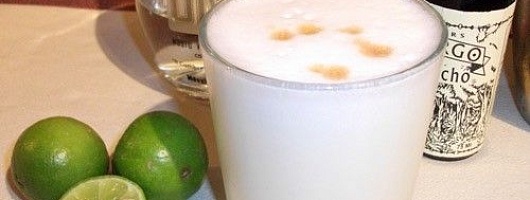
Peruvian Pisco Sour
Peru’s national drink and most popular cocktail is surely the famous Pisco Sour. It is the welcome drink in Peru and served for literally any occasion. In the original sense, Leche de Tigre (meaning Tiger’s Milk), is the marinating liquid left on the plate after having finished a Ceviche,…
 Salsa Criolla probably is the most important and most popular side dish in Peru. Prepared with red onions, aji amarillo, the juice of…
 Tequeños are known in all Latin America. In Peru, they are very popular as starter, light lunch or small snack in the evening at a bar…
 Peru’s celebrated cuisine is not only about famous chefs, outstanding dishes or the abundance of fresh fruits and vegetables, but as well…
 Papa rellena, meaning stuffed potato, is a traditional and popular dish full of Peruvian flavors which is eaten as starter, for lunch or…
 Tamales are a very traditional Latin American dish. In Peru Tamales come in many forms and sizes. Each region, even each town or family has…
 Chilcano, or also known as Chilcanito, is one of the most popular long drinks in Peru - and my personal favorite. It is based on Peru’s…
 Creamy, sweet Manjar Blanco embedded in two almost powdery cookies, this is a traditional, absolutely delicious and addicting Peruvian…
 A Cremolada is something between an ice cream and a flavorful fruit drink; comparable to slush, but made with lots of fresh fruit pulp,…
 Crema Volteada, literally meaning "upside down cream", is probably better known as the Peruvian version of Crème Caramel. Sweet and rich…
Legal Stuff

Extension of a Migraciones deadline
If Migraciones asks you to submit an additional document during the internal evaluation of an immigration-related application, you are usually given only a very short deadline to do so. If you already have the requested document,…
Subsanacion - Submitting documents
During the internal review of any application submitted via the Migraciones Agencia Digital, Migraciones may determine that a required document is missing, that an uploaded document does not meet their requirements, or that an… On May 2, 2023, the Peruvian government put a law (Ley 31732) into effect granting foreigners, who violated…
 If any personal information printed on your carné or registered in the Migraciones database changes, you must…
 Losing your Carné de extranjería (CE) or having it stolen or damaged can be stressful - especially since the…
 When your Peruvian residence visa is approved, you receive a Carné de Extranjería, Peru’s foreigner ID card.…
 In Peru, a residence visa - so, the permit that allows you to legally live in the country - is usually valid…
 Tourists who stay longer than the number of days granted upon entry to Peru must pay an overstay fine before…
 Peruvian minors, as well as underage foreign residents, need a special travel authorization to travel abroad…
 One of the requirements when applying for a resident visa in Peru or when changing your immigration status…
 Figuring out how many days you’re allowed to stay in Peru as a tourist isn’t always as straightforward as it…
 Peru is a beautiful country, the economy is booming, employment opportunities are everywhere, and living…
Peruvian Visa Types

Business Visa for Peru
Foreigners traveling to Peru for business purposes that do not involve employment or paid work must either apply for a business visa at a Peruvian consulate or, if eligible for visa-free entry, ensure they are admitted as a…
Peruvian Digital Nomad Visa
On November 14, 2023, a modification of the Foreigner Law, Decreto Legislativo 1582, was published, introducing a resident visa for digital nomads, remote workers, and freelancers in Peru for the first time. Some family members of Peruvian nationals and foreigners with resident status in Peru have the right to family reunification and can apply…
 Priests and pastors, members of religious orders, missionaries and other individuals who wish to stay in Peru to perform religious or…
 Foreign nationals who want to apply for a residence visa in Peru, for example because they are married to a Peruvian, have found work in…
 Foreigners who receive a state or private pension - including a social security pension, government pension, employment-related pension,…
 Foreigners planning to study at a Peruvian educational institution or to complete an internship or apprenticeship (without remuneration) at…
 Planning a trip to Peru is exciting, at least until visa questions start popping up. Do I need a visa? How long can I stay? What am I…
 While Peru has a volunteer visa, the so-called “visa cooperante” (cooperation visa), getting one is such a bureaucratic mess and in most…
 Foreigners who have a valid and legally signed work contract with a Peruvian company that has been approved by the Peruvian Ministry of…
The History of Peru
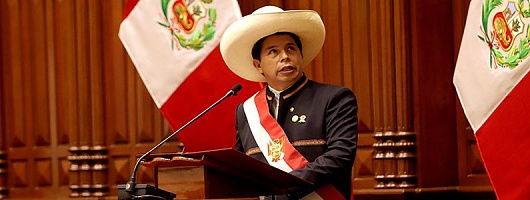
President Pedro Castillo from 2021 to 2022
The 2021 presidential election saw far-left Pedro Castillo, a political greenhorn in Lima, and hard-right Keiko Fujimori, who is not only the daughter of former president Alberto Fujimori, but as well an old-timer on the…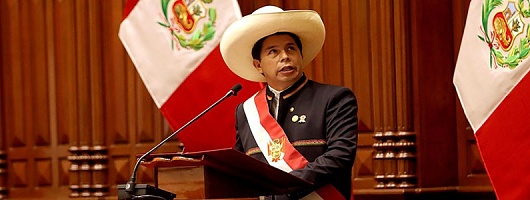
Pedro Castillo (1969 - )
José Pedro Castillo Terrones is a former member of the Rondas campesinas, elementary school teacher and union leader. He was the President of Peru from July 28, 2021 until he was removed from office on December 7, 2022. On Acuri's thirteenth birthday, his father, the thunder god Paricaca, said: "My son, disguise yourself as a…
 Pacha, (in allusion to “Pachamama” is a goddess revered by the indigenous peoples of the Andes. In Inca…
 A long time ago, the Shipibo of the Ucayali River lived in Cumancava, a place surrounded by rain forests,…
 Something or someone made a terrible noise in the bush. So long and deep was that noise that one of Paulita’s…
 Near the sea in the area of the Peruvian desert coast lay one of the most beautiful vegetable gardens. It is…
 Maria Reiche was born on the 15th of May 1903 in the historic city of Dresden, the German center of art and…
 In the 1920s, when people first flew across southern Peru, they made an astonishing discovery. Stretching…
 As a mixed-race man born in Peru, Saint Martin de Porres is a representative of three continents; his mother…
 Ana Velázquez hurried out of the barrios of Lima and onto the plaza. She carried a quiet baby, wrapped…
 Long ago, when men and women worshipped the sun for its warmth and life, there lived a mighty Inca Emperor.…
Peruvian Money Guide
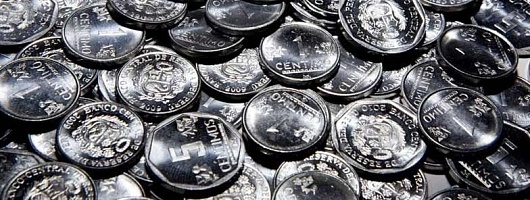
Current Peruvian Coins
Like the current Peruvian banknotes, the Peruvian coins in circulation reflect the country's rich historical and cultural past, but additionally as well Peru’s abundance of natural wealth. Their high-quality and beautiful…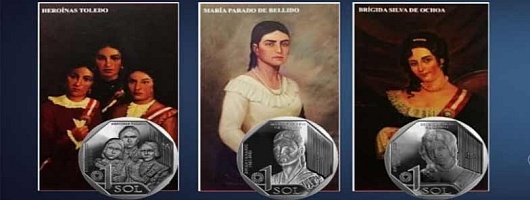
The Woman in the Process of Independence Coin Series
In commemoration of the bicentenary of Peru's independence from Spain, the Peruvian Central Reserve Bank (BCRP) issued the numismatic series “La Mujer en el proceso de la Independencia” (The Woman in the Process of Independence).… In commemoration of the bicentenary of Peru's independence from Spain, the Peruvian Central Reserve Bank…
 The numismatic series "Fauna Silvestre Amenazada del Perú" (Threatened Wildlife of Peru) was issued by the…
 The numismatic series "Recursos Naturales del Peru" (Natural Resources of Peru) was issued by the Peruvian…
 The numismatic series "Riqueza y Orgullo del Perú" (Wealth and Pride of Peru) was issued by the Peruvian…
 The current banknotes of Peru are not only lovely with famous Peruvian personalities on the front and either…
 Peru hasn’t got a tipping culture or obligation as we know them from other countries and usually Peruvians…
 With Peru becoming extremely attractive with travelers, expats and investors over the past years, and family…
 When traveling you of course need money. Even though debit and credit cards are at least in major cities…
 In Peru US Dollars and Euros can be exchanged to local currency, the Peruvian Sol, easily without…
 Over the past decade Peru established itself as the world leader in counterfeit money output producing the…

lima·easy - /ˈli mə/ - /ˈi zi/
This website is made by te-media - Creative Digital Solutions. All profits we make from it through advertising and other channels go back into the project. te-media also publishes:
In loving memory of "Jack" & "Lola"