
Before applying for any temporary or residence visa in Peru, all foreigners must first obtain the Ficha de Canje Internacional issued by Interpol. This means that before you can even start the so-called Cambio de calidad migratoria - whether from a temporary authorization (for example, a tourist stay) to another temporary or residence visa, or from one residence visa type to another - you must complete the Interpol clearance.
For many applicants, this step causes the most stress. In reality, however, the process is fairly straightforward - if you know how it works, understand the quirks of the appointment system, manage to secure an appointment and come well prepared.
Table of contents
- What is the Ficha de Canje
- Interpol offices in Peru
- Requirements for the Ficha de canje
- How to pay the fee for the Ficha de canje
- How to make an appointment at Interpol
- Interpol Visit
- Additional record check for US, Canadian and Australian citizens
What is the Ficha de Canje
The Ficha de Canje Internacional is a document issued by Interpol (the International Criminal Police Organization) certifying that a person is not an internationally wanted fugitive and does not have an “International wanted persons notice” (Red Notice).
The Ficha de Canje Internacional is a document issued by Interpol (International Criminal Police Organization) certifying that a person:
- is not internationally wanted, and
- does not have an active Interpol Red Notice
Contrary to popular belief, the Ficha de Canje is not a criminal background check. It does not replace the antecedentes policiales, penales y judiciales (criminal record certificate) from your home country when you apply for a residence visa.
Important:
For residence visa applications, Migraciones requires both:
- the Ficha de Canje issued by Interpol in Peru, and
- the Antecedentes policiales, penales y judiciales (criminal record check from your home country) with Apostille and certified translation.
You can find detailed information about the second requirement in our article
“International document corresponding to the Antecedentes policiales, penales y judiciales in Peru.”
Interpol offices in Peru
While for many years Interpol services were only available in Lima, several provincial offices now also issue the Ficha de Canje. This is especially helpful if you live far from the capital or if cannot get a timely appointment in Lima.
Interpol offices issuing the Ficha de Canje:
- Lima
Av. Manuel Olguin block 6, Monterrico, Surco - Arequipa
Seguridad de Estado, Calle San Francisco 214, Arequipa - Chiclayo
Segunda Macro región Policial, Calle Manco Capac 205, Chiclayo - Cusco
Complejo Policial 6 de Diciembre, Av. 28 de Julio, Wanchaq, Cusco - Piura
Division de Investigación Criminal, Complejo Policial Carretera Panamericana Piura-Sullana km 2.5 - Trujillo
Com. Policial Cap, Calle Toribio Mogrovejo 370, Urb. San Andres, Trujillo
Required documents for your Interpol clearance
The list of requirements looks intimitating. Just carefully read through it (don't miss the explanatory notes that answer most of your questions) and forget about the requirements that don't apply to you and your specific situation. Then just neatly organize document by document in a folder and you are ready for your Interpol appointment.
- Application form (provided at the office)
- Printed appointment confirmation
- Passport
- Photocopy of the passport page with personal data and photo (1)
- Proof of legal entry
- (Entry stamp)
- printed TAM virtual (2)
- Passport photos (taken at the Interpol office free of charge)
- Payment receipt (original and photocopy)
- Authority: PNP Policia Nacional del Peru
- Code 08141 - Ficha de canje Internacional (Interpol)
- Fee S/ 31.50 (2026)
- Sometimes requested though not officially listed
- Original + copy of a utility bill (“recibo”) showing your address in Peru (doesn't have to be in your name) (3)
- second identity document (can be an ID card, driver's licence or similar from your home country) mostly only requested at the Arequipa office
- Black pen (a remnant from Covid times; usually available, but better bring one)
- Additional required documents depending on your situation
- Family visa applicants:
- Other visa applicants:
- Occasionally Interpol asks for proof of the basis of your visa application
- for example:
- work visa applicants: work contract
- retirement visa applicants: letter of your pension fund
- student visa applicants: enrollment certifcate
- for example:
- Occasionally Interpol asks for proof of the basis of your visa application
- Foreign residents:
- Carné de extranjería + copy
- Special requirements for US, Canadian, and Australian nationals
- US Americans:
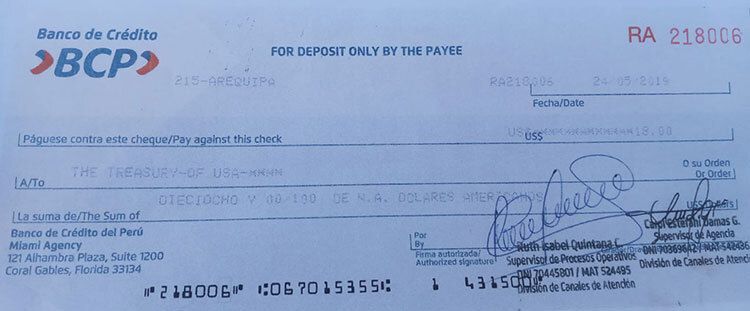
- International money order (Giro sobre el exterior / Giro Miamifor the amount of US$ 18.00, made out to "The Treasury of the USA), or
- FBI criminal record check with Apostille and translation + copy (accepted at least at the offices in Lima and Arequipa) (4)
- Canadians:
- International money order (Giro sobre el exterior for the amount of CAD$ 26,75, made out to "The Receiver General for Canada"), or
- RCMP certified criminal record check with Apostille and translation + copy (accepted at least at the offices in Lima and Arequipa) (4)
- Australians:
- International money order (Giro sobre el exterior for the amount of AU$ 99.00, made out to "The Australian Federal Police"), or
- AFP national police clearance certificate (NPC) for criminal records that cover all Australian states and territories with Apostille and translation + copy (accepted at least at the offices in Lima and Arequipa). (4)
- US Americans:
Explanatory notes
(1)
You may be asked to write your address and phone number on the passport copy and sign it.
(2)
Since May 2023, Peru no longer stamps passports on entry. As a copy of the entry stamp in your passport used to be - and officially still is - a requirement, download your TAM virtual to prove your legal entry.
To prove your legal entry, download your TAM virtual from the Migraciones website. For more information about the TAM (virtual), see our article How many days did I get when entering Peru?. Under chapter “Option 1: Migraciones website” you will find a detailed explanation how to download the TAM
(3)
In Arequipa, applicants are almost always asked for a second photo ID (driver’s license, national ID card, etc.), even though this is not an official requirement.
(4)
Officially, the following additional requirement still exists for US Americans, Canadians and Australians:
- an international money order (Giro sobre el exterior or Giro Miami) issued by BCP, payable to:
- USA: “The Treasury of the USA” - USD 18.00
- Canada: “The Receiver General for Canada” - CAD 26.75
- Australia: “The Australian Federal Police” - AUD 99.00

Important update since July 2024: At least the Interpol offices in Lima, Arequipa and Cusco now accept - and sometimes specifically request - a copy of your criminal record check from your home country (with Apostille and certified Spanish translation) instead of the money order.
As obtaining the money order has always been difficult, having your criminal record check, which you will need for a residence visa application anyway, ready may save you significant time and frustration.
That said, since the money order is still listed as an official requirement, acceptance of the criminal record check instead depends on the office (confirmed for Lima, Arequipa and Cusco). If you want to be on the safe side, be prepared for both scenarios.
According to official sources, you should be able to obtain the money order at any BCP branch. Unfortunately, this isn't true. Some branches seem completely unaware of the service, while others are only willing to issue it to BCP clients with US Dollar accounts.
Since the money order is no longer required at the Interpol office in Lima, Arequipa and Cusco, you will likely struggle to find a BCP branch there issuing one.
In Trujillo, you should be able to get the money order at the BCP branch on Av. Larco, in front of UCV, but you must be accompanied by someone who has a BCP account.
How to pay the fee for the Interpol clearance
As with all administrative procedures in Peru, before you can book an appointment and submit your application, you must first pay the corresponding fee — either in person at any Banco de la Nación branch or online via the pagalo.pe website from a computer or through the pagalo.pe app on a smartphone or tablet.
You can find detailed instructions on how to make the payment, what to watch out for, how to register on the online payment platform, and how to locate the correct fee in our article “Paying administration charges and processing fees in Peru.”
For paying the Ficha de Canje Internacional (Interpol) you need the code 08141 (on págalo.pe you can find it under Policia Nacional del Peru); costs are S/ 31.50 (2025).
Once the payment is done, keep the receipt safe. You will need it when making the appointment.
How to make an appointment at Interpol
Once you have paid the application fee at a Banco de la Nación branch or on pagalo.pe, you must book an appointment on the Interpol website. It's no longer possible to simply show up at an Interpol office or make an appointment in person.
Some hurdles to conquer - technical issues
If the page won’t load or freezes, try reloading it. Be aware that any information you had already entered may be lost, and you may need to start over. It can also help to use a different browser and/or clear your cache.
Please note that the Interpol appointment page generally only works if you are physically in Peru. So, if you are in Peru but using a VPN set to another country, turn it off. If you are outside Peru and want to book your appointment before arriving, try using a VPN set to Peru. Sometimes this works, sometimes it doesn’t.
To avoid additional system errors, we also recommend not using automatic translation tools that translate the page from Spanish into another language, and turning off any ad blockers or incognito/private browsing modes you may be using.
That covers the general technical issues of the Interpol appointment page.
Some hurdles to conquer - availability of appointments
Interpol office in Lima
Be aware that it can be difficult or sometimes even impossible to get an appointment at the Interpol office in Lima. For quite some time now, Interpol has been releasing new appointments for the Lima office only on Saturday mornings. As demand is high and capacity is limited, this means that, in practice, you can only snag an appointment on Saturdays between 08.00 am and 12.00 pm. This has been causing complete chaos for months and puts people who need to apply for residency as soon as possible, for example, because their stay as a tourist is running out, under significant time pressure.
Technically, if not all appointments for Lima are taken by Saturday at 12.00 pm, you can still book after that or even on the following days. However, over the past months this has almost never happened, as appointments are taken quickly.
So, if you are in Lima and need an Interpol appointment, get up early on Saturday and spend a few hours in front of your computer to hopefully secure one.
And here’s a helpful tip from our reader Phil: "If you're on the page where you need to select your sede [so the Interpol office] and appointment time and it doesn't load, just reselect the sede or the date and wait, if the spinner stops or you see an error it probably didn't work and you can reselect. You don't need to press F5 to reload the page, doing so will lose all the input data from your comprobante."
Interpol offices in the provinces
For the Interpol offices in the provinces, new appointments are released on the 30th of each month, and these can be booked for the following month. Since appointments at the provincial Interpol offices are usually not in such high demand and are readily available, you are not restricted to booking exactly on the 30th; you can generally book an appointment on almost any day.
So, if you cannot get an appointment at the Lima office in a timely manner, consider taking a trip to one of the provincial Interpol offices in Arequipa, Chiclayo, Cusco, Piura, or Trujillo to obtain your Ficha de Canje.
Step-by-step guide on how to book your appointment on the Interpol website
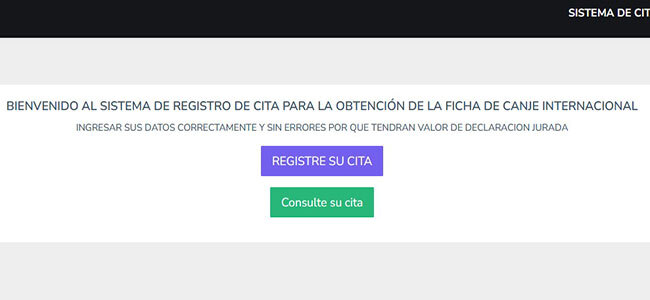
To schedule an appointment go to the Interpol website, where you will arrive at the following page.

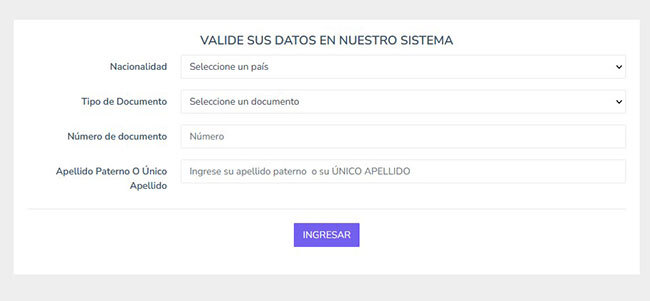
Just click on Registre su cita and you are directed to this page.

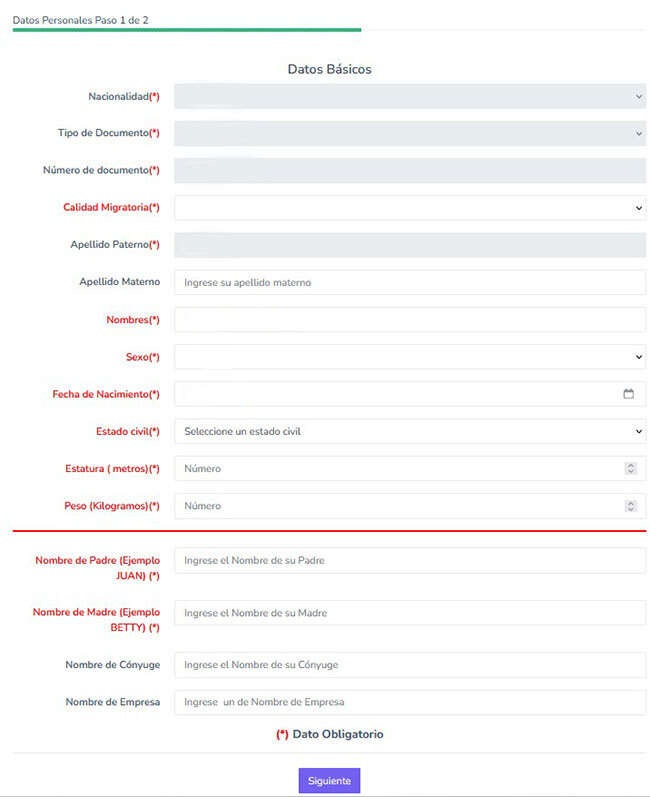
Now just fill in required fields:
- Nacionalidad (Nationality): In the drop-down list search for your home country. Be aware that the names are in Spanish, so, for example, you won't find US or United States, look for Estados Unidos (EEUU). Additionally, the countries aren't sorted alphabetically, so you might have to search a while until you find your home country.
- Tipo de documento (Type of document): Select the document with which you entered the country (most probably passport, so pasaporte).
- Numero de documento (Document number): Enter your passport number.
- Apellido paterno (Last name): Enter your last name.
Then click on Ingresar and you get to the Datos Personales page.

Fill in required fields:
- Nacionalidad (Nationality): already filled in
- Tipo de documento (Type of Document): already filled in
- Numero de documento (Document number): already filled in
- Calidad Migratoria (Immigration status): In the drop-down list select the immigration status you are applying for. So, if you want to apply for a family visa (cambio de calidad migratoria a familiar residente), choose Cambio a inmigrante por familiar residente or if you want to apply for a retirement visa select Cambio a rentista.
- Apellido paterno (Last name): already filled in
- Apellido materno (Second last name): This field is not obligatory. If you only have one last name, leave it blank. If you have a second last name enter it here.
- Nombre(s) (First name(s): Enter your first name(s) as in your passport.
- Sexo (Sex): Choose your sex; masculino (male) or feminino (female).
- Fecha de nacimiento (Birth date): Enter your birth date.
- Estado civil (Marital status): Choose your marital status; soltero (single), casado (married), divorciado (divorced) or viudo (widowed).
- Estatura (Height): Enter your height in meter.
- Peso (Weight): Enter your weight in full kg.
- Nombre de padre (Father's first name): Enter the first name of your father.
- Nombre de madre (Mother's first name): Enter the first name of your mother.
- Nombre de conyuge (Name of your spouse): This field is not obligatory, so you can leave it blank. If you want you can enter the name of your spouse.
- Nombre de empresa (Name of your company):This field is not obligatory, so you can leave it blank. If you want you can enter the company you are working for.
As soon as you have filled in all the required fields, check that your personal data is 100% correct. Then click on Siguiente and you get to this page.

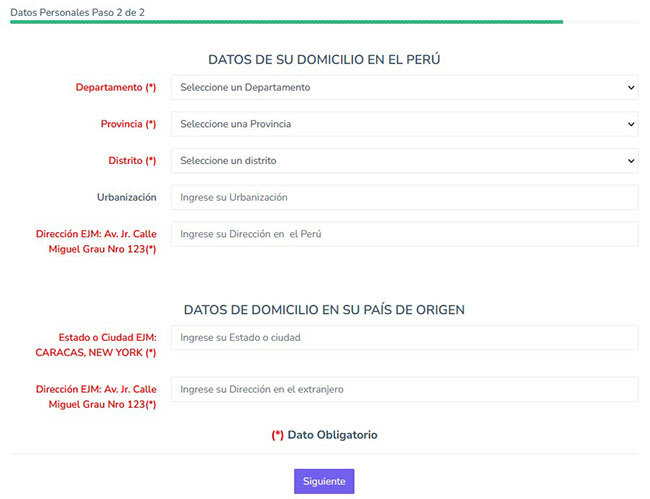
Now enter your current address in Peru, best exactly as on the "recibo" (water or electricity bill) you should bring with you just to make sure you have it in case the Interpol officer is asking for it.
- Departmento (Department): Enter the department (region, state); for example: Lima, Cusco, La Libertad, Madre de Dios, Ancash...)
- Provincia (Province): Enter the province; for example, Lima, Cusco, Trujillo, Tambopata, Huarmey.....)
- Distrito (District): Enter the district; for example: Miraflores, Cusco, El Porvenir, Las Piedras, Huarmey ...)
- Urbanizacion (Urbanization): This field isn't obligatory. You can enter here the area or housing development where you live.
- Direccion (address): Enter the street and house number where you live.
Below enter the last address in your home country.
- Estado o ciudad (State or city): Enter the state or city where you last lived in your home country.
- Direccion (address): Enter the street and house number where you last lived in your home country.
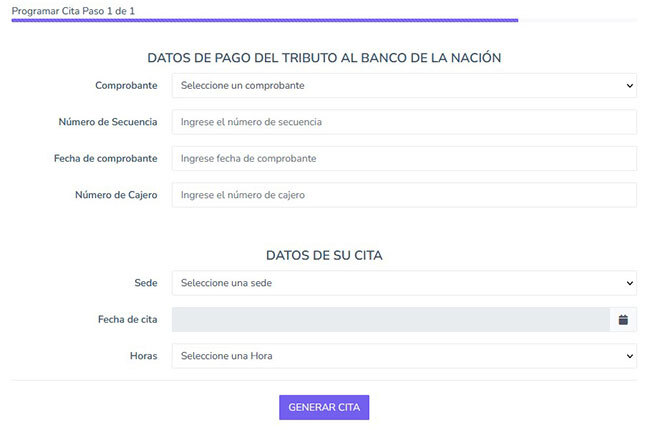
Once you are finished click on Siguiente and you get to the Programar Cita page.

Here under Comprobante first choose where you paid the fee (at a branch or on pagalo.pe) and then enter the required numbers from you pagalo.pe or Banco de la Nacion receipt.
- Numero de secuencia
- Fecha de comprobante
- Numero de Cajero
Then choose where and when you want your appointment:
- Sede (Branch): Select the Interpol office; Lima, Arequipa, Cusco, Chiclayo, Piura or Trujillo.
- Fecha (Date): Choose a date.
- Horas (Time): Choose a time.
Then click on Generar cita. I
If you are lucky, everything goes smoothly and you secure your appointment. Download the appointment confirmation, print it (!), and keep it safe.
When selecting the Interpol office in Lima, it is unfortunately common to see the message that no appointments are available at the moment or that the spinner just stops and the page freezes. The only thing you can do is try again by reselecting the sede and/or the date and hope it works.
As already explained in detail above Interpol releases new appointments on Saturday mornings for the Lima office and on the 30th of each month for the provincial offices.
So, if you want to get your Ficha de Canje at the Lima office, you may need to spend a few hours between 08.00 am and 12.00 pm at your computer trying to snag an appointment. Good luck. When time is an issue and you can’t get an appointment in Lima, another option is to obtain your Ficha at one of the Interpol offices in the provinces, where appointments are generally much easier to secure.
Interpol Visit
On the day of your Interpol appointment, arrive at the office 15 to 30 minutes early with all required documents and without accompanying persons (only individuals with disabilities may enter with one adult for assistance).
Especially in Lima, the situation in front of the office can sometimes appear chaotic. However, the staff is usually friendly and helpful; some English is spoken; the process is fairly well organized.
When you arrive at the Interpol office, go straight to the gate, where a guard will check your appointment confirmation and hand you a form to fill out. You will then be directed to the waiting area. In Lima (the process in the provinces may differ), simply take the first available seat and move forward one seat each time the person at the front proceeds to an officer. Once it’s your turn, hand over your documents.
The officer will quickly review your paperwork and then send you to have your photo taken. After that, you’ll undergo a brief visual check of your teeth, and then your fingerprints will be taken. That’s it.
For many months, the background check performed by Interpol before issuing the Ficha de Canje Internacional took an hour or more, and you had to return later that same day to pick it up. Now, however, the Ficha is issued immediately, so no more waiting or returning.
US, Canadian and Austrialian passport holders Be aware that in some provincial Interpol offices you may be sent to the nearby post office during your appointment to send your documentation for an additional check to the US, Canada, or Australia, and then return with the receipt before receiving your Ficha. However, if you already present a copy of your criminal record check from your home country with Apostille and translation, some Interpol offices accept this instead, meaning you may no longer need the money order or the additional mailing step.
With the Ficha in hand, you now can start your temporary or resident visa application process.
Additional record check for US, Canadian and Australian citizens
Please note: Since July 2024, US Americans, Canadians, and Australians are no longer required to present the money order at certain Interpol offices (confirmed for Lima and Arequipa) if they can show the original and leave a copy of their criminal record check from their home country with Apostille and official translation (which is needed for the visa application anyway). That’s one major headache less. Hopefully, this practice will soon be adopted by all Interpol offices.
As the money order is still listed as an official requirement for US Americans, Canadians, and Australians and not all offices are accepting a current criminal record check in place of the money order we are keeping the explanation for the additional criminal record check below:
If you are a citizen of the US, Canada, or Australia, an additional criminal record check from the federal police authority of your home country (for example, the FBI) is required. For this, the international money order mentioned above is needed. This check is not related to issuing the Ficha de canje required for your visa application at Migraciones or to the approval of your visa. Instead, if something serious appears on your record, it will be flagged, and you could be detained when leaving the country.
Be aware, that Interpol asks you to send an envelope with your documents to the FBI (for US citizens), the RCMP (for Canadian citizens) or the AFP (for Australian citizens). A few of our readers, who applied for the Ficha at an Interpol office in the provinces, were sent to the postal office nearby during the appointment and had to return with the receipt before getting their Ficha.
Additionally, receiving the results can take many weeks or even months, and the criminal record check you receive does not meet the requirements set by Migraciones. It does not come with an Apostille either. Therefore, waiting for this document and trying to use it as the “Antecedentes” required for a residence visa application is not recommended and usually counterproductive, as you will most likely run out of time on your tourist stay before the document is issued, apostilled abroad, and returned to Peru.
It is therefore best to come to Peru already prepared, bringing your criminal record check with Apostille from home or - if you are already in Peru - apply for it independently. You can find more information about the required criminal record check and how to obtain it in our article “International document corresponding to the Antecedentes policiales, penales y judiciales in Peru.”
Please note: We from LimaEasy are not a Peruvian government agency, a public authority or (immigration) lawyers. All information is published to our best knowledge and should be seen as general guidance introducing you to Peruvian regulations and procedures. All information is subject to change, as regulations, requirements, and processes can change quickly without prior notice!
And if you find something wrong on this page, please help us to keep this guide as up to date as possible and contact us either below with a comment or use our contact form. Thank you!