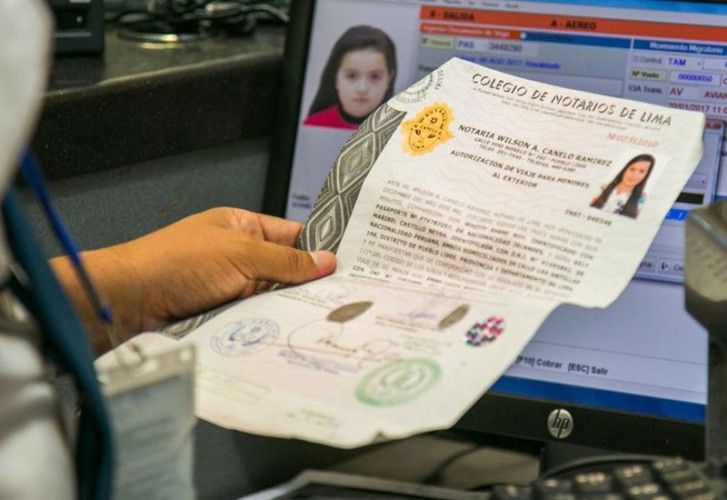

Peruvian minors, as well as underage foreign residents, need a special travel authorization to travel abroad (meaning to leave Peru) alone, accompanied by only one parent or another adult, or to travel alone within Peru. If this authorization isn’t presented, the minor will not be allowed to leave the country or, if traveling alone domestically, to continue the journey. So it’s best to be prepared to avoid last-minute surprises or stressful situations.
Table of contents
- General information about the travel authorization for minors
- Notarial travel authorization
- Consular travel authorization
- Judicial travel authorization
General information about the travel authorization for minors
A travel authorization is an official document signed by the mother and/or father allowing their underage child to travel alone within Peru or to go abroad alone, with only one parent, or with another adult.
If a Peruvian minor or underage foreign resident travels
- with both parents, no authorization is required.
- abroad with only one parent, the travel authorization signed by the other parent is necessary.
- alone or with another adult, whether inside Peru or abroad, both parents must sign the travel authorization.
Depending on the situation, the travel authorization is issued by different authorities in Peru or abroad:
- Peruvian notary
A notarial travel authorization is required- when the child travels alone or with another adult in Peru or abroad
- when the child travels with only one parent abroad
- Peruvian consulate
A consular travel authorization is necessary- when one or both parents are abroad
- Peruvian family court
A judicial travel authorization is necessary- when the minor travels abroad and both parents are absent
- when the minor travels abroad and one parent is absent
- when one parent doesn’t agree that the minor's travel abroad
Sounds complicated? A little, yes - but in practice most families only need a notarial travel authorization. The following sections will help you quickly identify which case applies to your situation and what to do next.
Travel authorization for minors issued by a Peruvian notary
A notarial travel authorization can be issued by any licensed notary in Peru. Depending on the situation, different documents are required and either one or both parents must appear at the notary’s office to sign the authorization.
For traveling in Peru
When a Peruvian minor or underage foreign resident travels within Peru:
- Alone or with another adult: only one parent must be present at the notary and sign the authorization.
- With one parent, no travel authorization is required.
General requirements for a notarial travel authorization for traveling in Peru
- Birth certificate of the minor (*)
- DNI or carné (for foreign residents) of the minor
- DNI or carné (for foreign residents) of the mother or father
- Notaries may also request travel details such as date of departure and return, point of departure and destination, means of transport (for example airplane with flight number, bus, car, or train), and, if applicable, details of the responsible adult (full name and ID/passport number). It’s best to have this information ready.
- Copies of all documents
(*) If the birth certificate was issued abroad, it must carry an Apostille or if issued in a country not part of the Apostille Convention be legalized by a Peruvian consulate. Birth certificates not in Spanish must be officially translated in Peru.
For traveling abroad
When a Peruvian minor or underage foreign resident travels abroad:
- Alone or with another adult: both parents must be present at the notary and both must sign the authorization.
- With one parent: only the non-traveling parent must appear and sign. However, the DNI/carné and passport of the traveling parent may also be requested, even if not officially listed as a requirement.
General requirements for a notarial travel authorization for traveling abroad
- Birth certificate of the minor (*)
- DNI or carné (for foreign residents) and passport of the minor
- DNI or carné (for foreign residents) and passport of the parents
- Additional documents, if applicable:
- If one parent has sole custody: sometimes the minor’s consent is sufficient, but notaries may request legal proof
- If one parent is deceased: death certificate
- If one or both parents are abroad: a consular travel authorization is required (see corresponding section)
- Notaries may also request travel details such as date of departure and return, point of departure and destination, means of transport (for example airplane with flight number, bus, car, or train), and, if applicable, details of the responsible adult (full name and ID/passport number). It’s best to have this information ready.
- Copies of all documents
(*) In case the birth certificate was issued abroad, it must have an Apostille or, if the country in which the document was issued didn't sign the Apostille Convention must be legalized by a Peruvian consulate. If the birth certificate is not in Spanish, it must be translated in Peru.
How to get the notarial travel authorization
Visit any licensed notary in Peru and request an Autorización de viaje para menores de edad. Present the required documents and pay the fee. In most cases, the authorization is issued within a few hours on official paper from the Peruvian Association of Public Notaries, signed and stamped by the notary.
Carefully check that all names and personal details match the passports and that the travel information is correct.
A notarial travel authorization is valid for 90 days and for one trip only. When the minor leaves Peru, the document is presented at immigration and is usually retained. Therefore, it’s wise to keep a copy (ideally a certified one) for your records in case it is needed later during your travels.
Travel authorization for minors issued by a Peruvian consulate
If one or both parents of a minor in Peru are abroad, they must request a travel authorization at a Peruvian consulate so the child can leave Peru - whether traveling alone, with only one parent, or accompanied by another adult.
General requirements for a consular travel authorization
- Birth certificate of the minor
- DNI or carné (for foreign residents) and passport of the minor
- DNI or carné (for foreign residents) and passport of the parents
- Additional documents, if applicable:
- If one parent has sole custody: sometimes the minor’s consent is sufficient, but consulates may request legal proof
- If one parent is deceased: death certificate
- Consulates may also request travel details such as date of departure and return, point of departure and destination, means of transport (for example airplane with flight number, bus, car, or train), and, if applicable, details of the responsible adult (full name and ID/passport number).
How to get the consular travel authorization?
Contact the nearest Peruvian consulate to learn about the current requirements and exact procedure, as these can vary slightly by location.
On the website of the Peruvian Ministry of Foreign Affairs (RREE) you can find a world map of all Peruvian consulates abroad. Clicking on a location marker shows the consulate’s address, phone number, email, and - if available - its website.
Important notes:
- A travel authorization issued by a Peruvian consulate must be legalized by the Ministry of Foreign Affairs (RREE) in Peru before the child can leave the country.
- Like other travel authorizations, it is valid for one trip only. When the minor leaves Peru, the document is presented at immigration and is usually retained. Therefore, it’s wise to keep a copy (ideally a certified one) for your records in case it is needed later during your travels
Special case:
If one parent is abroad and the other is in Peru, and the minor travels abroad alone or with another adult, both parents must give their consent separately.
- The parent abroad must obtain the authorization at a Peruvian consulate.
- The parent in Peru must additionally get a notarial travel authorization in Peru.
Travel authorization for minors issued by a Peruvian court
If a minor needs or wants to travel abroad and:
- both parents are absent, or
- one parent plans to travel with the child but the other parent cannot be located, or
- one parent does not agree to the child traveling abroad,
then a judicial travel authorization can be requested at a Peruvian family court.
The application can be filed by the parent who intends to travel, the minor represented by an adult, or the legal guardian.
Requirements for a judicial travel authorization
- Birth certificate of the minor (*)
- DNI or carné (for foreign residents) and passport of the minor
- DNI or carné (for foreign residents) and passport of the applicant
- Any additional documents relevant to or supporting the specific case
(*) In case the birth certificate was issued abroad, it must have an Apostille or, if the country in which the document was issued didn't sign the Apostille Convention must be legalized by a Peruvian consulate. If the birth certificate is not in Spanish, it must be translated in Peru.
How to get the judicial travel authorization?
- First, pay the fee for the “Autorización judicial de viaje para menores de edad” at any branch of the Banco de la Nación.
- Then, submit the documents at the Mesa de Partes of the local family court.
- Usually, the court schedules an interview with the applicant and the minor within a reasonable time frame.
After reviewing the documents and evidence, the court will either deny the request or issue the judicial travel authorization.
Processing time and important considerations
Peruvian courts are not known for being fast. If one or both parents are absent, the judge may first order a public notice. This alone can delay the process by 14-30 days.
Additionally, the court may involve the Reniec or Migraciones, which can add several more weeks. So it’s best not to expect a quick resolution.
Validity
- The judicial travel authorization is valid for one trip only.
- When leaving Peru, it must be presented at immigration together with the officially signed court decision.
- Since the original is usually retained, keeping a copy - ideally a certified one - is highly recommended in case it is needed later during your travels.
Please note: LimaEasy is not a Peruvian government agency, public authority, or law firm. The information provided is based on our best knowledge and is intended as general guidance to help you understand Peruvian regulations and procedures. Regulations, requirements, and administrative practices may change at any time and without prior notice, so we recommend verifying current details with the relevant authorities before acting on this information.
And last but not least: If you notice any inaccuracies or outdated information on this page, please help us keep this guide up to date by leaving a comment below or contacting us via our contact form. Thank you for your support!